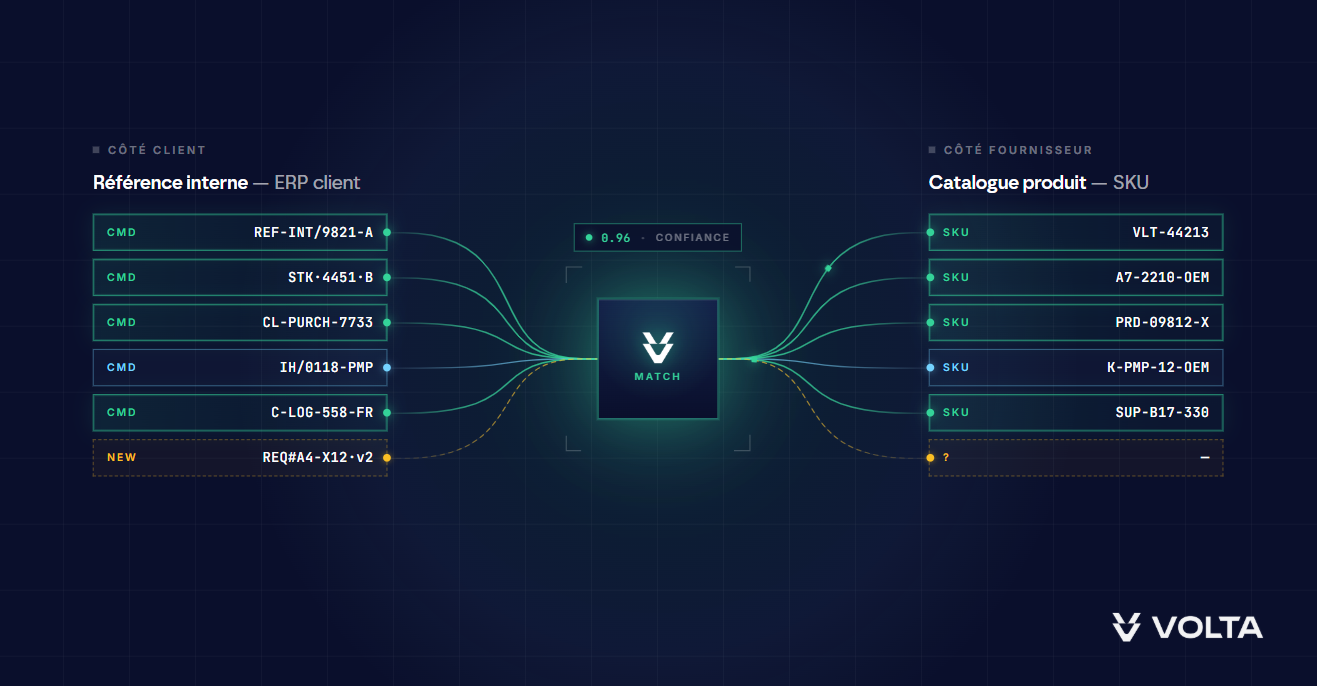

In distribution and wholesale, across every vertical, one phenomenon is almost universal: clients order using their own internal references. Not the supplier's. Theirs. And it is precisely this gap that order management teams spend a considerable amount of time resolving, manually, every day.
An everyday reality across every sector
Whether it is a hospital ordering consumables, a manufacturer replenishing components, or a distribution chain placing supply orders, the pattern is always the same. The client has created an internal reference in their ERP that belongs to them, often built according to their own coding logic, and that is the reference they use on their purchase orders.
This is not negligence or bad faith. It is the normal functioning of a structured organisation: every buyer manages an internal catalogue that lets them control their stock, budgets, and price comparisons across suppliers. The internal client reference is the cornerstone of that system. It will not change to accommodate the supplier's catalogue.
The result: the supplier receives orders containing codes that match nothing in their own catalogue. And yet those orders still need to be processed quickly and without error.
Why managing internal client references is more complex than it appears
Reference matching seems like a simple mapping problem: link client code X to supplier code Y, once and for all. In straightforward cases, that is exactly what happens.
But reality is more complicated:
- The same product may have multiple internal references depending on which purchasing department places the order within the same client organisation.
- A reference may change following an ERP update on the client side without the supplier being informed.
- A client may use partial labels, abbreviations, or spelling variants that match no exact entry in the mapping table.
- New clients arrive regularly with their own codes and no prior history.
Static mapping table approaches quickly reach their limits: permanent manual feeding, inability to handle variants, complete failure against unknown references. Unresolved cases end up systematically in manual processing, with all the delays and costs that entails.
What Volta changes in practice
Volta approaches internal client reference matching with a fundamentally different logic. Rather than searching for an exact match in a fixed table, it reasons across all available signals: the label associated with the reference, the order context, the client's history, the relevant product families.
When an unknown internal reference arrives, Volta does not give up. It analyses the available clues, the partial label that often accompanies the reference, consistency with past orders, the nature of products usually ordered, and proposes a likely match with an explicit confidence level. The operator confirms in seconds.
And that is where one of Volta's major strengths lies: every validation enriches its knowledge. A reference confirmed once becomes a consolidated match for future orders. The tool learns continuously, without manual reconfiguration, progressively reducing the share of cases that require human intervention.
Immediate and lasting operational gain
The impact is twofold.
In the short term, Volta drastically reduces the volume of orders queued for manual processing due to unrecognised references. Processing times improve, input errors decrease, and teams focus on genuine exceptions rather than repetitive matching tasks.
In the medium term, Volta builds a living knowledge base of each client's ordering habits, an operational asset that grows in value over time and makes the business more agile when onboarding new clients or adapting to changes in existing client practices.
In a context where speed and reliability of order processing are direct drivers of client satisfaction and competitiveness, the ability to resolve internal reference issues intelligently is no longer a technical detail. It is a competitive advantage.
Are your teams still spending time matching codes manually?
Volta intelligently resolves internal client reference issues and continuously learns each client's ordering habits. See how it works in practice.