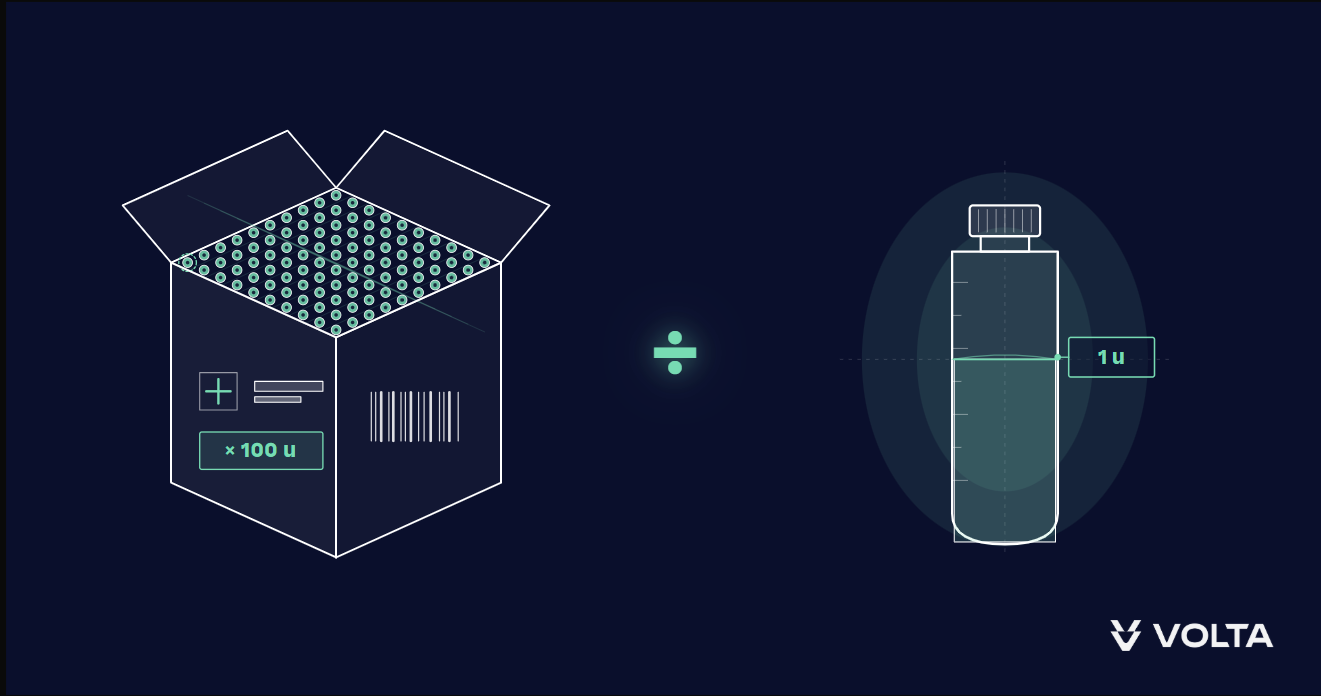

In distribution and wholesale, automated order processing has advanced significantly with AI tools like Volta. For the vast majority of transactions, processing runs smoothly. But there is a category of cases, concentrated in specific verticals, that demands even more advanced capabilities: sub-unit recognition in client orders, a packaging mismatch that traditional tools simply cannot resolve.
Sub-units and packaging: why certain sectors are particularly exposed
Sub-units are not universal. They appear mainly in sectors where packaging varies significantly from one supplier to another: medical devices, personal protective equipment (PPE), industrial supplies, hospital pharmacy, and laboratory consumables.
The logic is simple and rational. A hospital buyer ordering needles from several suppliers faces a comparability problem: one sells in boxes of 100, another in boxes of 200. To compare prices accurately and feed their procurement dashboards correctly, they record the product in their ERP at the unit level, meaning per needle, and send orders accordingly. Their order therefore arrives with a quantity of 5,000 needles, whereas the supplier only knows boxes of 100.
This is not a client error. It is a deliberate and coherent practice on their part. But it is precisely this gap between the client's purchasing logic and the supplier's sales logic that order scanners need to be able to resolve.
Why traditional tools struggle with these packaging conversion cases
Traditional scanners work well when an order is expressed in the catalogue's sales unit. As soon as a client deviates by sending a quantity in sub-units, the system breaks down.
Rule-based approaches require configuration client by client, product by product, and permanent maintenance whenever a packaging format changes. The result: these orders fall into manual processing, slowing throughput and consuming resources on tasks that add no value. In sectors like medical or PPE, where catalogues evolve regularly, this maintenance is an operational drain.
What Volta delivers on sub-unit conversion
Volta is highly effective at handling these situations. Rather than applying static packaging conversion rules, it reasons from context: which product, which client, what order history, how consistent is this with known catalogue packaging?
When an order arrives with a quantity expressed at the unit level for a product sold in boxes, Volta identifies the gap, infers the likely packaging conversion, and proposes a reasoned interpretation with an explicit confidence level. The operator validates in seconds rather than re-entering manually.
Over time, Volta consolidates each client's habits, making these cases progressively smoother to handle, without reconfiguration. The knowledge base grows richer with every interaction.
A concentrated but significant impact on hidden costs
These cases do not represent the majority of orders. But in the sectors concerned, medical, PPE, hospital pharmacy, industrial supply, they can account for a substantial share of manually processed volume and therefore significant hidden costs.
Automating sub-unit and packaging conversion intelligently means:
- Reducing turnaround times on urgent orders, particularly in hospital environments
- Making conversions reliable and eliminating manual input errors
- Freeing up teams for higher-value tasks
This is precisely where Volta makes the difference, not by handling standard cases better, but by intelligently covering the cases that other tools leave in the queue.
Are your medical or industrial orders still falling into manual processing because of unit mismatches?
Volta natively handles sub-unit and packaging conversions, and learns each client's habits over time. See how it works in practice.